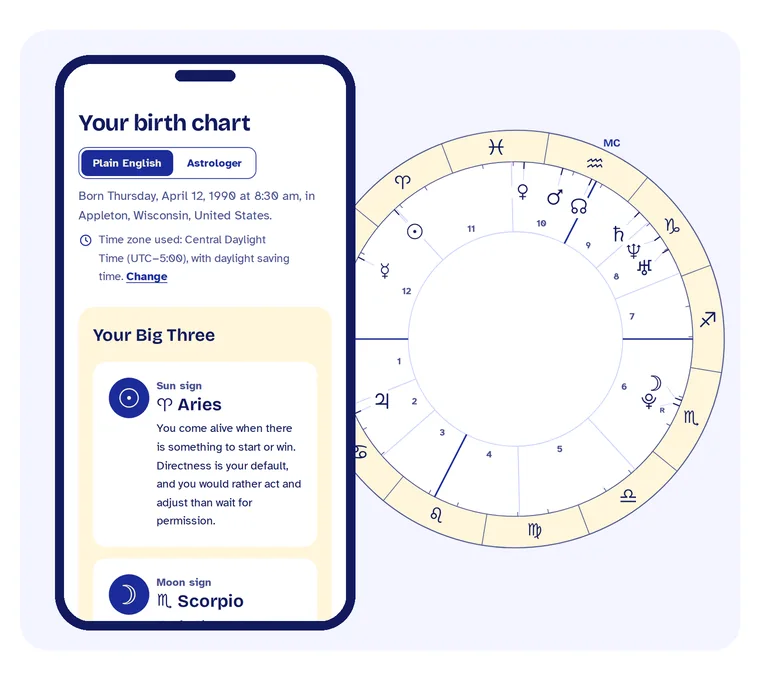
What is a birth chart?
A birth chart, also called a natal chart, astrology chart or zodiac chart, is a map of where the Sun, Moon and planets were at the exact minute you were born, as seen from the place you were born. Astrologers read it as a portrait of your temperament: what drives you, what you need, and the parts of life where those themes play out.
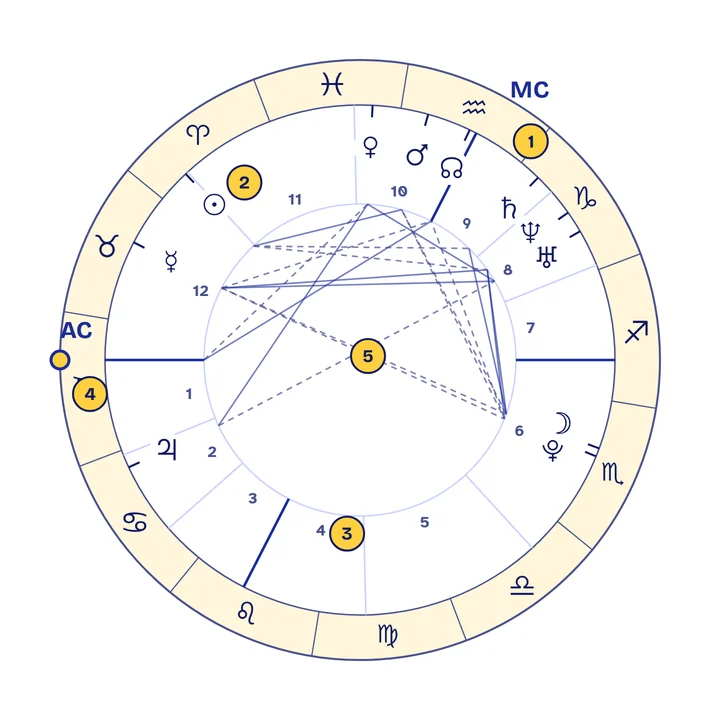
- The zodiac signs. The outer ring holds the 12 signs in order from Aries to Pisces, each 30 degrees wide.
- The planets. Each one sits at its exact degree, which places it in a sign. In this chart the Sun is at 22 degrees Aries.
- The houses. Twelve slices, numbered counterclockwise from the rising sign, show which area of life each planet affects.
- The angles. AC, the Ascendant, marks your rising sign on the eastern horizon at the left. MC, the Midheaven, is where the zodiac crossed the meridian, the line through the top of the sky, at your birth.
- The aspects. Lines in the center join planets that sit at meaningful angles to each other, such as 90 or 120 degrees.
A birth chart isn't a star map in the astronomy sense. It ignores the constellations and tracks the planets against 12 equal signs measured from the spring equinox. For a slower tour of every part, read what a birth chart is and how to read one.
The planets in your chart
Each planet stands for one part of your personality, and its sign shows how that part behaves. Astrologers call all ten "planets" for convenience, even though the Sun is a star and the Moon is a moon.
- SunYour core self: what gives you energy and purpose.
- MoonYour feelings: what comforts you and how you react.
- MercuryYour mind: how you think, learn and talk.
- VenusLove and values: what you find beautiful and how you relate.
- MarsDrive: how you go after what you want.
- JupiterGrowth: where you expand and find opportunity.
- SaturnDiscipline: where you work hardest and mature.
- UranusChange: where you break from tradition.
- NeptuneDreams: where you imagine, hope and sometimes drift.
- PlutoRenewal: where you go through deep change.
Uranus, Neptune and Pluto move so slowly that everyone born within a few years shares their signs, so astrologers pay more attention to the houses they fall in. Your results also show the North Node, which many astrologers read as the direction you're growing toward.
Signs, elements and modes
Every sign has an element, which describes its basic temperament, and a mode, which describes how it handles change. Together they explain why two people with the same Sun sign can still feel so different once you look at their other planets.
Fire
Energy, courage and enthusiasm
- AriesCardinal
- LeoFixed
- SagittariusMutable
Earth
Practical, patient and grounded
- CapricornCardinal
- TaurusFixed
- VirgoMutable
Air
Ideas, talk and connection
- LibraCardinal
- AquariusFixed
- GeminiMutable
Water
Feeling, intuition and closeness
- CancerCardinal
- ScorpioFixed
- PiscesMutable
Cardinal signs start things, fixed signs keep them going and mutable signs adapt. Your results count how many planets fall in each element and mode, which is a quick way to see the overall tone of your chart.
The 12 houses in your chart
The 12 houses divide your chart into areas of life, starting from your rising sign on the left and running counterclockwise. A planet's sign shows how it behaves, and its house shows where that behavior shows up.
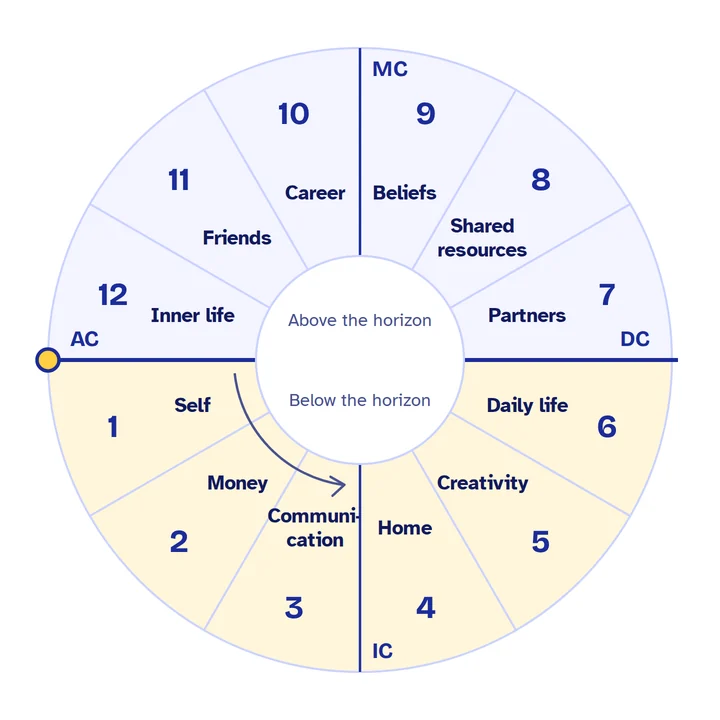
| House | Area of life |
|---|---|
| 1st | Self: your personality, appearance and the way you start things |
| 2nd | Money: income, possessions and self-worth |
| 3rd | Communication: everyday talk, learning, siblings and your neighborhood |
| 4th | Home: family, roots and private life |
| 5th | Creativity: romance, fun, self-expression and children |
| 6th | Daily life: work routines, health habits and service |
| 7th | Partners: marriage and one-on-one relationships |
| 8th | Shared resources: joint money, intimacy and deep change |
| 9th | Beliefs: philosophy, higher learning, travel and the big picture |
| 10th | Career: reputation, public life and ambition |
| 11th | Friends: groups, communities and hopes for the future |
| 12th | Inner life: solitude, rest and what happens behind the scenes |
For a full chapter on each one, see the 12 astrology houses explained.
What you need to make your birth chart
You need three things: your date of birth, your time of birth and the city or town where you were born. The date and place fix the planets and the local time zone, and the time fixes your rising sign and houses, which change fastest.
Where to find your birth time
In the US, the best source is your birth certificate, and the time usually appears on the long-form version rather than the short abstract many people carry. You can order a long-form copy from the vital records office in the state where you were born; the CDC lists every state's office on its Where to Write for Vital Records page.

If the certificate has no time, try these:
- the hospital where you were born, if its records go back that far
- a baby book, birth announcement or local newspaper notice
- your parents or other relatives, ideally someone who was there
A time someone remembers as "around 3 in the afternoon" is still useful. Enter it, and the results will show how long your rising sign holds around that time.
Why the time zone matters
Your birth certificate records local clock time, so the calculator has to know which time standard your town used that day, including whether daylight saving time was in effect. Get it wrong by an hour and your rising sign can move a whole sign.
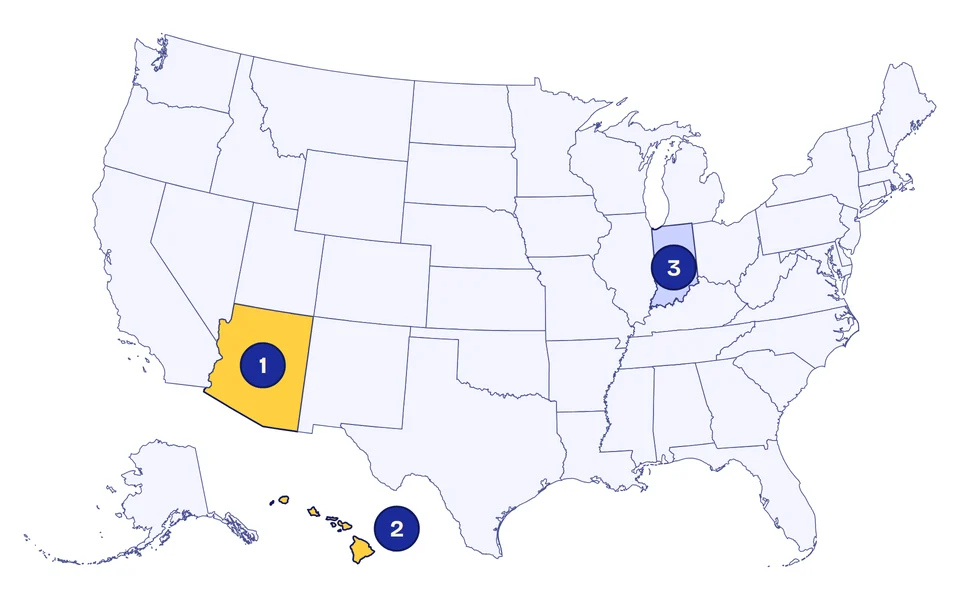
- Arizona has stayed on standard time all year since 1968. The Navajo Nation, in the state's northeast, is the exception and does observe daylight saving time.
- Hawaii does not observe daylight saving time.
- Indiana did not observe daylight saving time statewide until 2006, and some of its counties have switched between Eastern and Central time.
Two national quirks catch people out too. The whole country stayed on daylight time all year from February 1942 to September 1945, known as War Time, and again for most of 1974 during the energy crisis. Before 1967, cities and states set their own daylight saving rules. The calculator applies all of this automatically, and if a family record says your town did something different, use the Change link next to the time zone in your results.
How exact does your birth time need to be?
Within about 15 minutes is good enough for most charts. Your rising sign changes roughly every two hours and the house lines move about one degree every four minutes, while the planets barely move in that time.
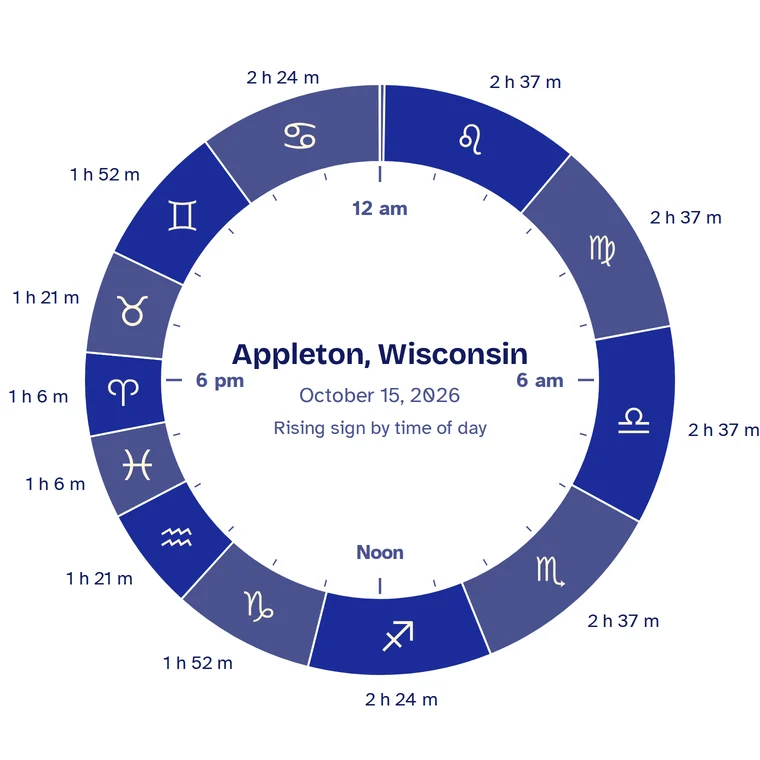
How long a sign takes to rise depends on your latitude. In Appleton, Aries and Pisces each rise in just over an hour, while Leo, Virgo, Libra and Scorpio take about 2 hours 37 minutes each. If you were born while one of the quick signs was rising, a few minutes matter more.
Your results show the exact window your rising sign covers on your birth date. If your time falls within 15 minutes of a change, you'll see a note naming the sign on the other side of it.
Can you make a birth chart without a birth time?
Yes. Without a birth time your Sun sign and planets are almost always certain, but your rising sign and houses are not, and on about 44 days in 100 the Moon changes sign during the day.
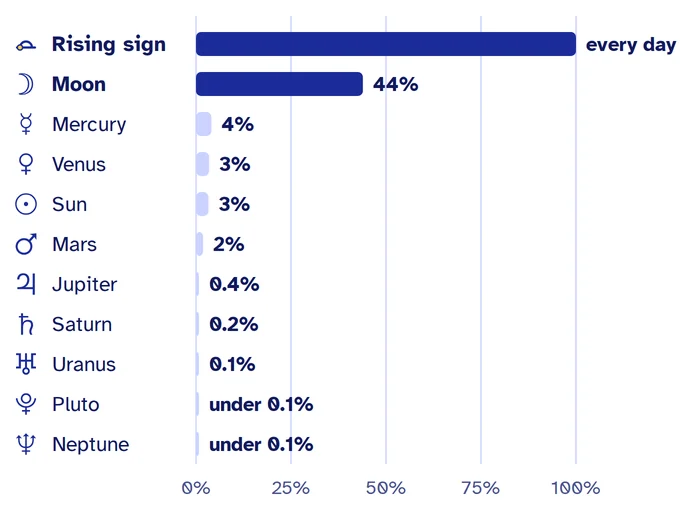
Tick "I don't know my birth time" in the form and pick a rough window if you have one. The calculator then shows which placements are certain, both possible Moon signs with the clock time the Moon switched, and every rising sign that falls in your window. Many astrologers use a noon chart in this situation; showing the full range tells you more than a single guess does.
If you find your birth time later, run the chart again. Even a window of a couple of hours is often enough to settle your rising sign.
How to read your birth chart in five steps
Read your birth chart from the general to the specific: start with your Big Three, then your chart ruler, the houses, the aspects and finally the patterns.
- Start with your Big Three. Your Sun sign describes your core self, your Moon sign your emotional needs and your rising sign how you come across. Read them as a team rather than three separate verdicts.
- Find your chart ruler. The planet that rules your rising sign colors the whole chart. Its sign and house show where your attention naturally goes.
- See which houses hold planets. Houses with several planets are busy areas of your life. Empty houses are normal and don't mean that area is missing.
- Read the tightest aspects. Aspects within about 3 degrees are the ones people feel most. Trines and sextiles tend to flow; squares and oppositions create friction that pushes you to grow.
- Notice the patterns. A stellium, a lopsided element balance or several retrograde planets are themes that repeat across the whole chart.
Our guide to reading a birth chart walks through each step with a worked example.
Placidus or whole sign houses?
Placidus is the default here because it's the house system most modern Western astrologers and chart sites use. Whole sign houses are older and simpler, and they're popular again with astrologers who work with traditional techniques. You can switch between them in the astrologer view.

In whole sign houses, each house is exactly one sign, starting with your rising sign. Placidus divides the sky by time instead, so its houses come in different sizes, and they get more uneven the farther from the equator you were born. Close to the poles Placidus can't be calculated at all, so the calculator switches to Porphyry houses there and tells you so.
If a house reading never quite fit you, try the other system. Neither one is the single correct answer, and many astrologers look at both.
Why another site may show a different sign
Most differences come from four settings: the zodiac, the house system, the time zone and the birth time itself. Check them in that order.
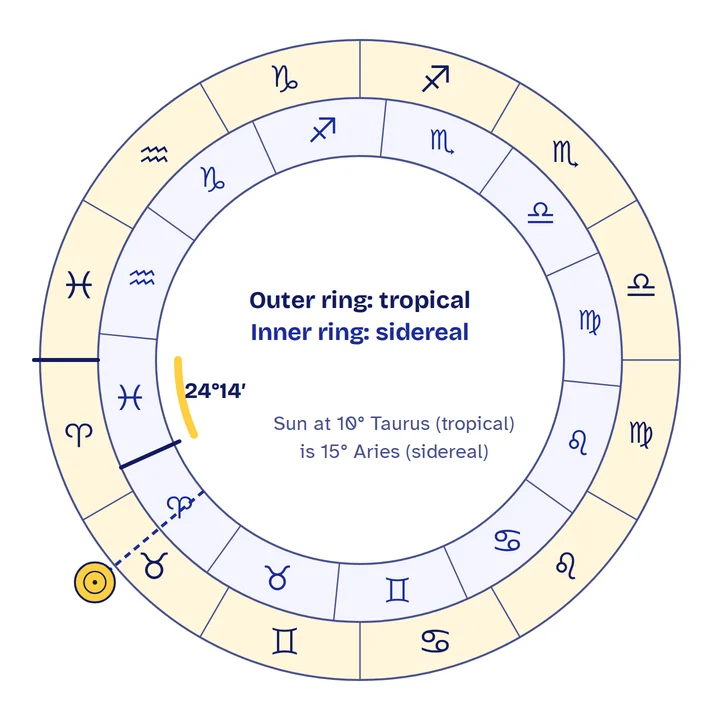
- The zodiac. Western astrology uses the tropical zodiac, which is tied to the seasons. Vedic astrology uses the sidereal zodiac, which is tied to the stars and currently sits about 24 degrees behind. That moves most placements back one sign, so a Taurus Sun often becomes an Aries Sun.
- The house system. Placidus and whole sign houses can put the same planet in neighboring houses, as the sample chart above shows.
- The time zone. A site that applies the wrong daylight saving rule is an hour off, which can change your rising sign.
- The birth time. If you typed slightly different times into two sites, a rising sign near the edge of a sign can flip.
Questions people ask
Is this birth chart calculator really free?
Yes. There's no sign-up, no paywall and no limit on how many charts you make.
Is a natal chart the same as a birth chart?
Yes. Natal comes from the Latin word for birth, and astrologers use natal chart and birth chart for the same thing. Older books also call it a nativity or a horoscope, a word that first meant the chart itself rather than a daily forecast.
Can I make a birth chart for my baby?
Yes, and a newborn's chart is often the most accurate one you'll make, because hospitals record the minute of birth. Use the time on the hospital record and the city where the hospital is, not your home address.
Do you keep my birth details?
No. The chart is calculated in your browser, and your birth details are never sent to us or shared with advertisers. If you press Save on this device, the chart is stored in your browser's local storage, and clearing your browser data removes it.
Can I share or print my chart?
Yes. Copy share link puts your birth details into the link itself, so anyone you send it to can open the same chart; share it only with people you trust. Print gives you a clean page with your Big Three, wheel and placements.
Where are Chiron and Lilith?
The full chart covers the Sun, the Moon, the planets from Mercury to Pluto and the lunar nodes. Chiron has its own page, the Chiron calculator, with room to explain how it is worked out and read. Black Moon Lilith will get its own calculator later.
Can I see my Vedic chart here?
Partly. Switch the zodiac to sidereal in the astrologer view to see your planets with the Lahiri ayanamsa, the setting most Vedic astrologers use. A full Vedic chart, with nakshatras and the North or South Indian layout, will have its own calculator.